Back to work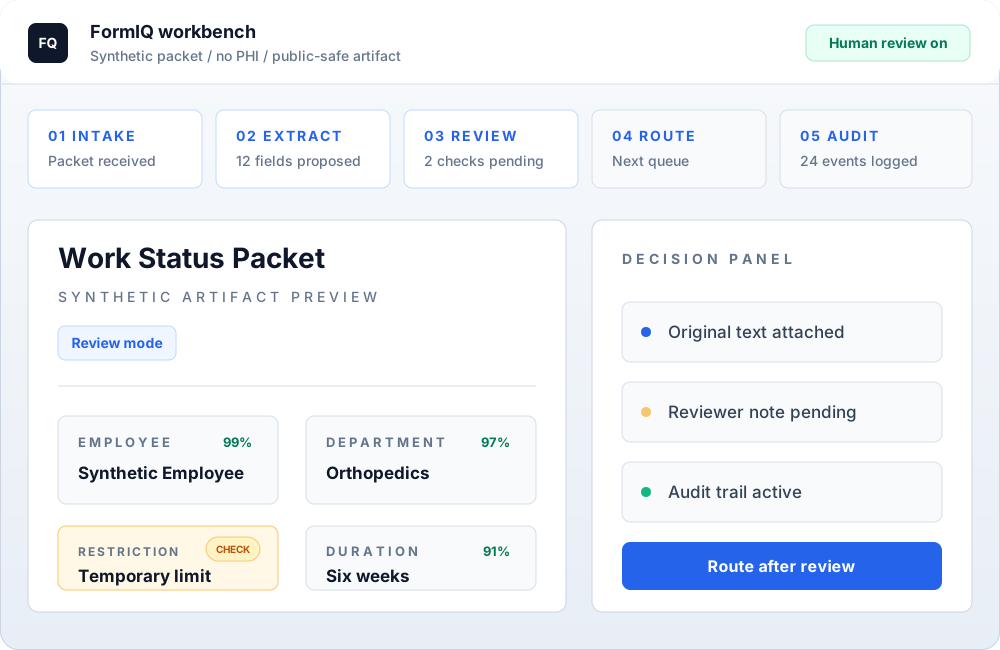
Co-founder and tech lead
FormIQ
AI workbench for healthcare document intake, extraction, review, and routing.
Problem
Healthcare teams receive scanned packets, faxes, and digital forms that still need manual identification, field extraction, review, routing, and traceability. The hard part is not only OCR; it is turning model output into a reliable operating workflow that clinicians, administrators, and IT teams can trust.
Users
Physicians and clinical reviewers
Administrative intake teams
Yale IT and digital health stakeholders
Department workflow owners
What I built
Turned stakeholder discovery into product specifications, review states, and a roadmap for a regulated document workflow.
Built intake, classification, extraction, exception handling, routing, human review, and audit-history surfaces.
Architected the full-stack product across Rust, Python/FastAPI, React/TypeScript, PostgreSQL, authentication, Docker/Helm, and observability.
AI / technical approach
Prompt-based classification and structured extraction over PHI-sensitive document workflows.
Model-swappable OCR and text analysis so the workflow is not locked to one provider.
Schema checks, required-field logic, and review states around model output before downstream routing.
Reliability controls
Human approval remains in the path before final action.
Source wording stays visible next to normalized fields so reviewers can inspect the evidence.
Exception queues, audit events, status visibility, and operator dashboards make ambiguity visible instead of hidden.
Business or operating impact
Moved from prototype to Yale Orthopedics proof-site work, executive demos with Yale stakeholders, and due-diligence conversations.
Tested against thousands of documents in a small Yale Orthopedics pilot/proof-site context.
Internal model suggests roughly 10,400 admin hours per year in time savings for one department, based on 20 hours per admin per week across 10 admins.
One-department internal value model suggests approximately $500K in annual opportunity; broader department-level expansion should be treated as scenario modeling, not realized savings.
Refined the product after learning that the real department workflow differed from the first assumed workflow.
Created a public-safe evidence layer that shows product judgment without exposing PHI or sensitive implementation details.
Public / private boundary
No PHI, real patient documents, private prompts, or public source code.
No certification-style compliance language, deployment overstatement, or realized-savings language.
Public evidence uses synthetic data, diagrams, and conservative wording.