Back to work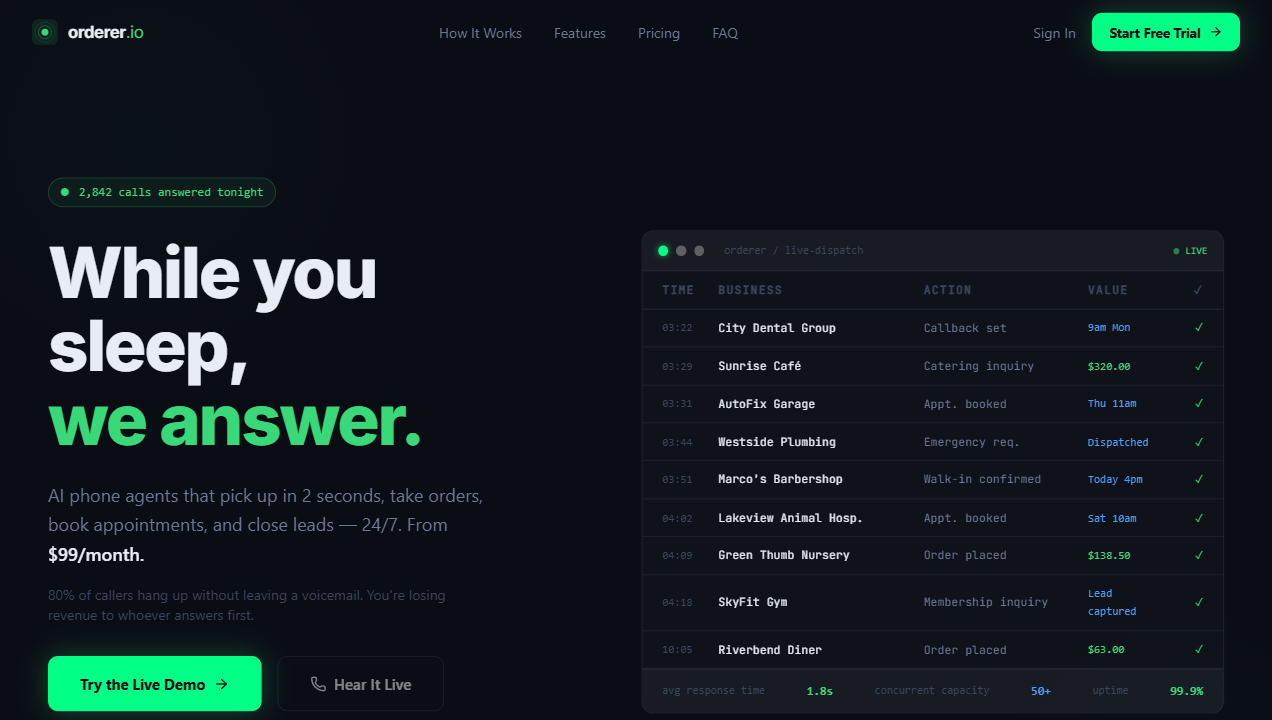
Founder
Orderer.io
Live voice AI phone ordering built from restaurant operating experience.
Problem
Restaurant phone orders are an operational bottleneck: calls arrive during rush periods, customers expect immediate pickup, and every missed or mishandled call can become lost revenue. I understood the problem directly from managing order takers, cooks, drivers, and VOIP/offshore coverage in a family restaurant.
Users
Restaurant owners
Managers
Order takers
Customers calling in orders
What I built
Real-time phone AI ordering that can answer calls, handle the conversation, capture order details, and move the order toward completion.
Streaming audio, barge-in support, transcripts, SMS/payment links, and web/admin surfaces.
A setup flow intended to make the product usable by operators without a long technical onboarding process.
AI / technical approach
Streaming speech-to-text, LLM conversation logic, and text-to-speech tuned for phone-order latency and reliability.
Order-state handling, transcript capture, and payment/SMS handoff.
Cost/performance service composition kept private as proprietary implementation.
Reliability controls
Real phone-call flow with order state rather than a static chatbot demo.
Transcript and admin surfaces for review.
Explicit handoff from conversation to order completion, SMS, and payment link.
Business or operating impact
Connects AI product building to a real operating problem I had already managed manually.
Tested with hundreds of calls and designed for family-restaurant use before any external paid customer claims.
Internal family-restaurant model suggests about $6K/month potential net savings if the workflow replaces order-taking coverage.
Demonstrates live voice AI product execution, not just a prototype.
Public / private boundary
Vendor blend, credentials, phone numbers, payment details, and routing logic stay private.
Avoid unsupported savings promises or competitor-comparison claims.
Use fake restaurant/order data in demos.